🧐 Estimated read time | 6 minutes


Last time, we stepped into the world of Alexander McQueen—his roots, his rebellion, and the raw emotion sewn into every collection. If you missed that introduction to the man behind the myth, you might want to start there. Today, we’re diving straight into the first of many recurring obsessions in McQueen’s work: FEATHERS.
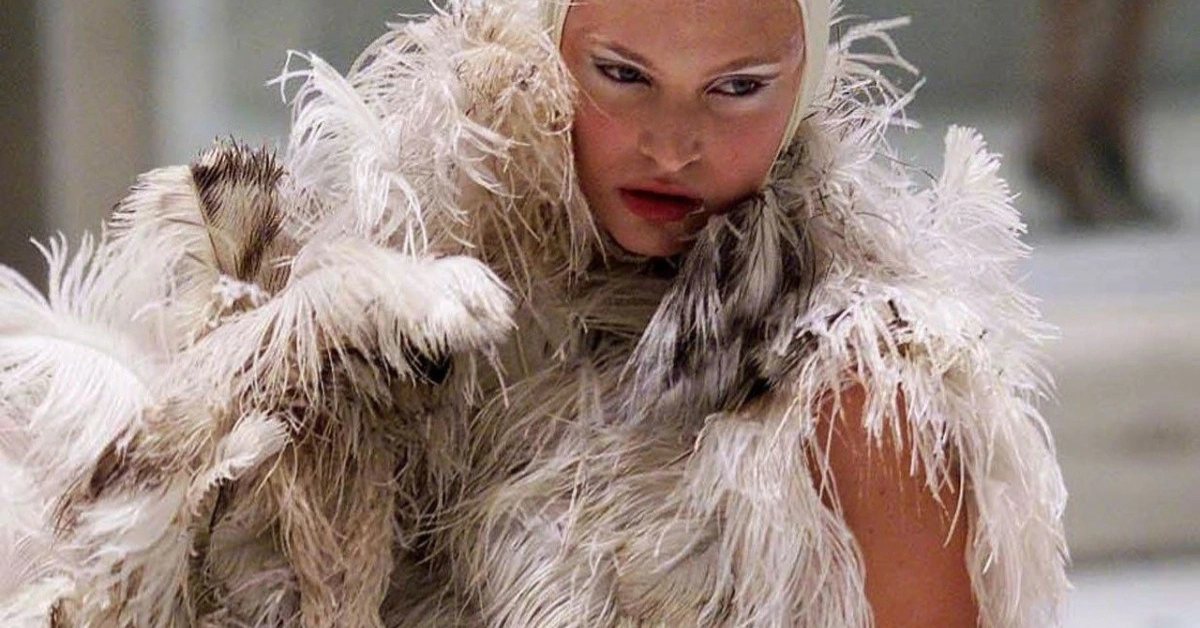
Who could forget the black duck feather dress from The Horn of Plenty collection? Or that golden duck feather coat from Untitled—my personal obsession. There’s a scene in VOSS, Alexander McQueen’s Spring/Summer 2001 show, where a model steps out in a red and black ostrich feather dress that looks more like a living, breathing organism than a piece of clothing. The feathers move, rustle, threaten. She doesn’t glide—she prowls. And just like that, you realise: this isn’t fashion. It’s defiance, wrapped in plumage.


Feathers have always spoken a language of their own—one that’s shifted meaning many times across centuries. In the Middle Ages, they crowned hats with an unmistakable message: status. The more exotic the bird, the more powerful the wearer. Ostrich, peacock, heron—these weren’t just decorative choices; they were social signals. Feathers meant privilege, wealth, and the right to be seen.
As fashion moved into the theatrical world of the 17th-century burlesque, feathers took on new connotations. They slipped from the heads of nobles to the bodies of performers, turning into tools of seduction—playful, provocative, and unapologetically bold.
Today, the feathers used in fashion mostly come from domestic birds—geese, roosters, chickens—dyed and shaped to evoke their wilder, more exotic counterparts. But even if the sourcing has changed, the symbolism hasn’t gone away. If anything, it’s expanded.


By the time Yves Saint Laurent sent his women down the runway in the 1960s, feathers had transformed once again. No longer just symbols of status or seduction, they came to represent something else entirely: freedom. Feathers became shorthand for self-expression, mobility, and the right to take up space. His women didn’t perch—they soared.
And then McQueen arrived. His women weren’t in flight—they were in battle.
Where Saint Laurent’s feathers symbolised freedom, McQueen’s took it further. His were not for ornament or ease. They bristled. They defended. Just as feathers shield birds from wind and rain, McQueen’s feathered creations became armour—designed to protect women from being reduced, stereotyped, or silenced.
But protection was only the beginning. His feathers weren’t merely defensive—they were offensive. They loomed, rustled, threatened. They announced the presence of a woman not to be underestimated. His use of plumage was intentionally theatrical, even confrontational—a challenge to anyone who tried to define femininity on conventional terms.
McQueen wasn’t just transforming women into birds. He was stripping away the metaphor entirely. These weren’t delicate creatures in need of flight—they were something altogether new. Genderless. Mythical. Powerful. An unclassifiable species, liberated from both stereotype and biology. Free to choose who or what to be.

“Birds in flight fascinate me. I admire eagles and falcons. I’m inspired by a feather but also its color, its graphics, its weightlessness and its engineering. It’s so elaborate. In fact I try and transpose the beauty of a bird to women.”
Duck Feathers


Before we ascend to the grandeur of ostrich feathers, it’s worth pausing for a moment to consider the quiet strength of a more understated bird: the duck. Often overlooked in fashion iconography, ducks hold a curious kind of symbolic power—one that McQueen understood and elevated with intention.
In several of his most compelling designs, McQueen employed duck feathers to dramatic effect. These pieces, layered and sculptural, are among his most arresting. Unlike the exoticism of peacocks or the luxury of swans, the duck, grounded yet versatile, carries a different kind of message. It walks, swims, and flies. It adapts. It moves between elements with ease. That very ability, in both nature and myth, has long been associated with personal freedom and transformation.
In Celtic mythology, ducks embody the balance between the physical, emotional, and spiritual realms. For McQueen, who was deeply connected to his Scottish heritage, this symbolism was not incidental. His use of duck feathers wasn’t merely a textural choice—it was conceptual. These garments didn’t just clothe the body; they imbued it with meaning. A woman wearing McQueen’s duck feather pieces became not a delicate creature, but a fully realised force, free to move, free to speak, free to exist without constraint.
McQueen didn’t miss the opportunity to channel that symbolism. His duck feather creations weren’t just beautiful—they were statements. Women wrapped in those plumage-heavy silhouettes weren’t being adorned. They were being armed. Empowered to move through the world—through any element, any space—with freedom and unapologetic presence.
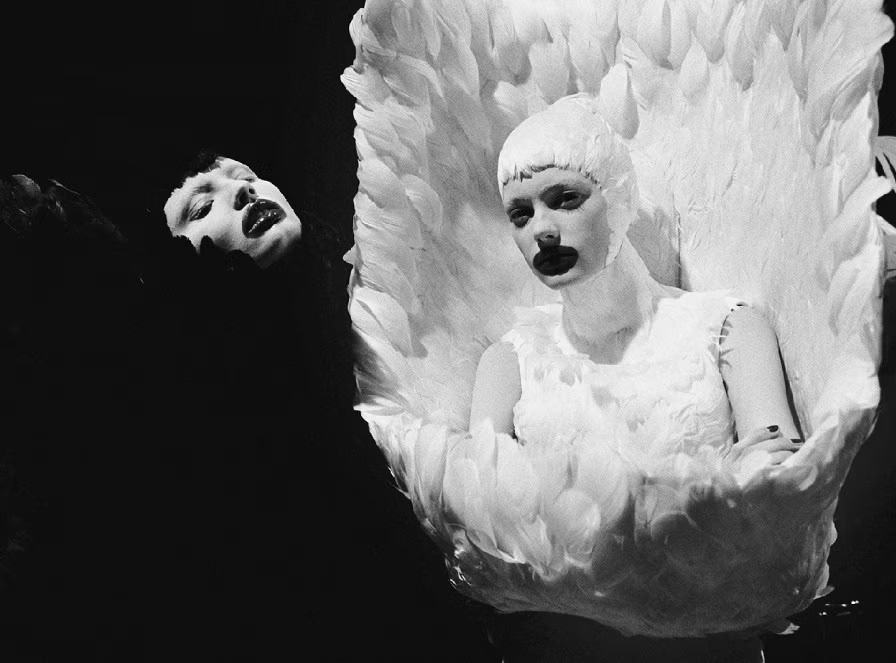
This is how Kristin Knox describes the white swan and the black raven in her book Alexander McQueen: Genius of a Generation:
“Despite the theatrics of this design, the soft, pure white plumage in which the model is wrapped, like an infant swan, exudes a vulnerability so innocent, so pure despite the costume-element – another of McQueen’s key aesthetic contradictions. In direct contrast to the white swan, this model represents the harsher realities of the avian world, appearing as a crow or a fierce bird of prey in this enormous and threatening all-black feather concoction.”
That’s the contradiction McQueen thrived in.
Ostrich Feathers

Historically, ostrich feathers have signified more than opulence—they’ve embodied dominance. From the Middle Ages through the 17th century, they adorned the hats of Europe’s elite, serving as visual markers of wealth, rank, and, particularly for men, sexual and physical supremacy (Williams, 2013). Cavaliers, in particular, wore plumes not only as fashion statements but as declarations of virility and command.
Though the widespread use of exotic feathers has diminished over time, one aristocratic emblem endures: the Prince of Wales’s heraldic badge. Comprising three white ostrich feathers emerging from a coronet, accompanied by the motto Ich dien—“I serve”—this insignia carries a legacy of nobility, duty, and restraint.
McQueen, who moved through the world of Savile Row and courtly tailoring early in his career, was undoubtedly familiar with its weight. But in his own work, ostrich feathers underwent a transformation. No longer passive symbols of tradition, they became shields—fierce, majestic, and unyielding. His use of the plume redefined its meaning, turning a sign of inherited power into one of self-made defiance. In McQueen’s hands, ostrich feathers didn’t flatter; they protected. They didn’t serve; they confronted. They became a form of armour, guarding women not with silence, but with unapologetic strength against the constraints of gendered expectation.

So, when you next see one of those famous feathered pieces, remember that you’re not looking at fashion. You’re looking at a rebellion, disguised as a dress. McQueen wasn’t just transforming women into birds. He was setting them free.
Love this post? Pin it!

Other Posts You May Like
-

Tabi Shoes: The Most Controversial Footwear In Fashion History
-

New Finds, Big Crushes: The Bag Brands I’m Loving Right Now
-

Why Are We So Mean Online? A Love Letter to the Worst Corner of the Internet
-

How Labubu Went From Weird Toy to $150K Must-Have: The Marketing Masterclass
-

Is Quiet Luxury Really Quiet?
-

The Feathered Rebellion: Alexander McQueen and the New Femme
Fancy a trip? Let’s plan it
-

Belgrade in 3 Visits: A Love Letter in Layers
-

The Ultimate Day Trip in Greece: Swim the Acheron
-

Why Everyone’s Falling in Love with Parga (and You Will Too)
-

Marmore Falls: Italy’s Wildest Waterfall, A Family Story, and Why You Need to Visit Now
-

Ljubljana Travel Mistakes to Avoid + What Made Us Fall in Love
-

Why You’ll Fall in Love with Tivoli’s Villa d’Este