🧐 Estimated read time | 6 minutes
Imagine this: You’re at a music festival in the middle of nowhere. Your friends have disappeared (probably queuing for overpriced Aperol or fries), there’s zero signal, and your battery is on its last legs. Usually, this would mean “goodbye world,” at least until you get Wi-Fi or any signal again.
Enter Bitchat — a new messaging app that wants to keep you connected, even when the internet says nope.

So, what is Bitchat?
Bitchat is a new creation by Twitter co-founder Jack Dorsey (yes, that Jack Dorsey). But unlike Twitter’s endless hot takes and memes, this app is all about quiet, direct communication.
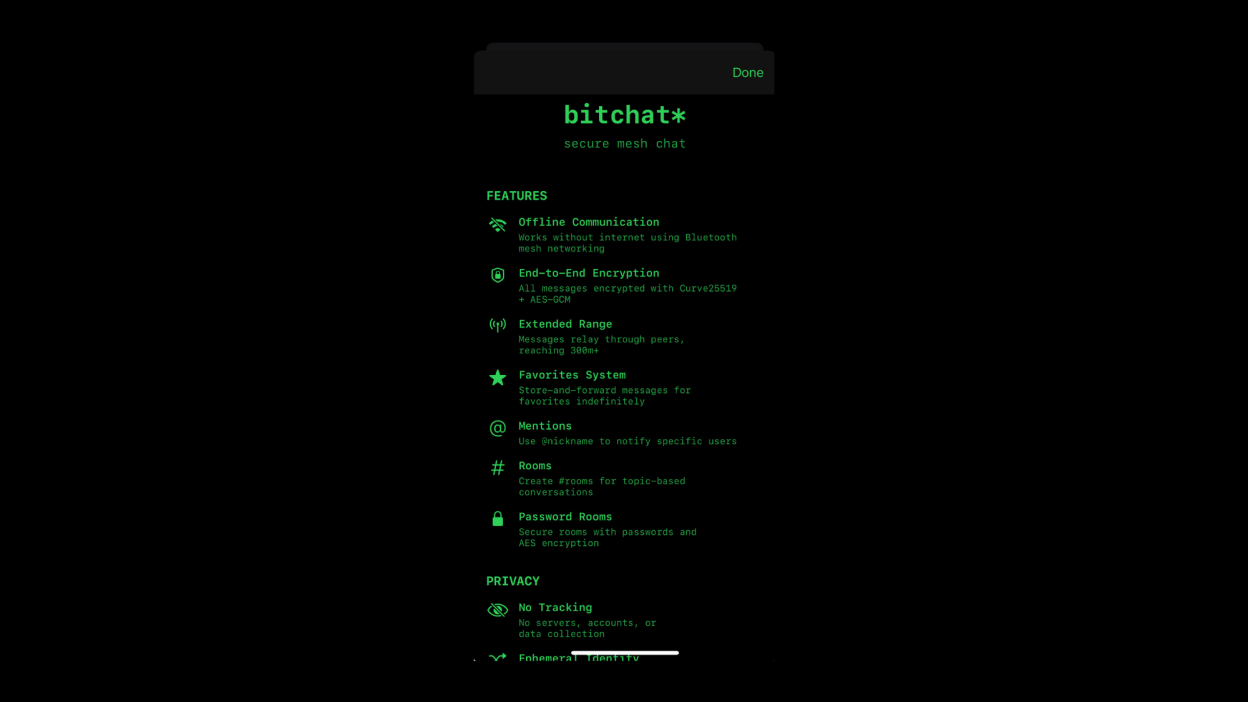
Instead of relying on Wi-Fi, mobile data, or even phone numbers, Bitchat uses something called a Bluetooth mesh network. Basically, your phone talks to another phone nearby, and that phone passes your message along — a bit like a digital game of whisper down the lane. No servers, no big tech middleman, no creepy data collection.
Messages even disappear after a while, leaving no trace behind. CIA potential, huh?
Why should you care?
If you’ve ever found yourself lost in a sea of festival-goers, at a protest where internet might be blocked or jammed, or simply annoyed by the idea of tech giants reading your every emoji, Bitchat might sound tempting.
It lets you send messages offline, no SIM, no internet, or signal required. And for travelers, adventurers, or anyone who values privacy, this opens up all kinds of possibilities. You can join group chats (called channels), send private messages, and even protect group chats with passwords.
How it really works
When I first heard about Bitchat, these were my initial questions — and probably yours too:
🙋♀️ How far can my message go? Like… to the next city?
Not quite. Bluetooth on its own only reaches about 30 meters (around 98 feet). Bitchat’s mesh network lets your message “hop” from one phone to another, so in theory it could stretch a few hundred meters if enough people are around to pass it along — but it’s definitely not going to reach the next city, let alone another country.
🙋♀️ So, can I text my mom in Greece while I’m chilling in New York?
Big nope. Bitchat is strictly local. No internet means no global reach, no matter how many friends (or random strangers) you convince to keep Bluetooth on.
🙋♀️ Wait… how many people actually keep Bluetooth on all the time?
Exactly. For this to work, people around you need to have Bluetooth on and be running Bitchat. In reality, most of us turn Bluetooth off to save battery or to avoid connecting to that one neighbor’s weirdly named speaker. So unless you’re at a Glastonbury, a packed protest, or a place where everyone’s intentionally using the app, coverage can be pretty hit-or-miss.
🙋♀️ Will it drain my battery like crazy?
This is a big one. Bitchat claims it uses adaptive power modes to be kind to your battery, but realistically, yes — leaving Bluetooth on and running an app that constantly scans for other devices will use more juice than usual. Just something to keep in mind before you head out with 12% battery.
🙋♀️ Do messages last forever?
No. Messages are designed to disappear after a while, leaving no trace. Perfect if you like living in the moment — and forgetting your midnight idea to start a goat yoga farm by morning.
Think of Bitchat less as a magical WhatsApp replacement and more as a digital walkie-talkie for local adventures — perfect when you’re all in the same area and the internet decides to take a nap.
A few more very normal questions you might be thinking
💬 How many people do I need around me for this to work well?
The more, the better. In dense areas (like festivals, protests, or big events), it can work surprisingly well. In a quiet village, on a solo mountain hike, or when you’re hiding from your responsibilities at home? Not so much.
💬 Do I need to keep the app open all the time?
Usually yes — or at least let it run in the background. Otherwise, your phone can’t receive or pass on any messages, and you basically become a dead-end in the mesh.
💬 Why is it called Bitchat?
Great question. Lots of people are amused (or totally confused!) by the name. Some think it sounds like “bitch at,” some see it as a cheeky branding move (fellow marketers, I see you). Either way, it definitely gets attention — which, let’s be real, might be the whole point.
💬 Do I need to sign up or make an account?
Nope. No accounts, no phone numbers, no email addresses. You just pick a nickname and start. The app is designed to be as private and frictionless as possible — a big part of its appeal.
💬 Can I use it to complain about my ex at a festival without them seeing?
Technically yes — if they’re not on the same mesh. But fair warning: Bluetooth can’t block emotional baggage.
💬 Can I try it? How do I download it?
Right now, Bitchat is in beta and only available to a limited number of iPhone users through Apple’s TestFlight program — and 10,000 spots filled up fast. There’s an Android version in the works, but no public release yet. If you’re super keen, you can check out their GitHub page to follow development or even try to build it yourself (if you’re feeling brave and techy).

The security catch
Of course, there’s always a “but.”
Right now, Bitchat is still in its early days. Security researchers have already pointed out vulnerabilities — like the risk of someone pretending to be one of your trusted contacts, or possible ways hackers could sneak into your conversations. Even Jack Dorsey himself has warned that the app hasn’t been fully reviewed for security and shouldn’t be used for anything sensitive (yet).
So, while the idea is super exciting, it might not be your best bet for top-secret plans or confessions of undying love (stick to a handwritten letter for that one).
The bigger picture
Beyond the tech, Bitchat hints at something much larger: a future where we aren’t so dependent on centralized networks. Imagine a world where we can communicate without internet providers, without data mining, and without surveillance.
It’s about independence and privacy — two things that are becoming more precious by the day.
Should you jump in?
If you’re the kind of person who loves being first to try a new app, go ahead. For most of us, it’s probably worth keeping an eye on Bitchat rather than relying on it right now.
The potential is huge, and if they iron out the security wrinkles, it could become a game changer for travelers, privacy lovers, and anyone looking to unplug — without really unplugging.
💬 What do you think? Is this the future of messaging, or just a fun side experiment? Let me know in the comments — and if you do end up trying it (safely!), I’d love to hear about it.
Love this post? Pin it!

Other Posts You May Like
-

How Last Crumb Made Cookies a $140 Luxury Obsession
-

The Street Art Dilemma: Illegal, Beautiful, and Unforgettable
-

Polyester Is the New Pill. And We Didn’t Consent
-

Capitalism, Creativity, and the Music Industry: A Crisis of Value
-

Why Are Girls Still Paying More? The Pink Tax, Exposed
-

Why Are We So Mean Online? A Love Letter to the Worst Corner of the Internet
-

How to Make Big Money in Your Own Small Business
-

The Brand Next Door: Notpla
-

Twitter Co-Founder’s New App Bitchat Promises Messaging Without Wi-Fi