🧐 Estimated read time | 5 minutes
There are places that feel like stories, long before you even arrive. Acheron is one of them.
In Greek mythology, Acheron wasn’t just a river. It was a passage. A boundary between the world of the living and the dead. Homer described it as the River of Woe, where the souls of the departed would be ferried by Charon across to Hades. According to legend, you didn’t just cross it. You surrendered to it.
What no myth prepares you for is the temperature. The water is freezing cold year-round. At the springs, it can be as low as 5°C, and even in the wider, slower-moving parts, it rarely rises above 10°C. Even in summer. This is not your average refreshing swim. It’s a full-body shock. The kind that makes you gasp, hesitate, then, strangely, want to keep going.
I didn’t expect to feel that mythology in my bones, but standing waist-deep in ice-cold water, somewhere between panic and awe, I began to understand why the ancients gave it that name.

A Place You Don’t Arrive At. You Enter.
We had decided to visit Acheron during our stay in Parga, the soft-spoken gem of the Greek mainland that I wrote about here. The idea was simple: a nature escape, a little walk by the river, maybe a few good photos. We packed lightly and optimistically. What we found, however, was not a trail. It was a transformation.
The drive from Parga takes about an hour. You follow winding roads inland until the sea disappears behind you and the hills close in. Eventually, you arrive in Glyki, a small village that looks like it could be the setting of a forgotten folk tale. At first glance, it doesn’t seem like the starting point of anything remarkable. But that’s how these things begin.
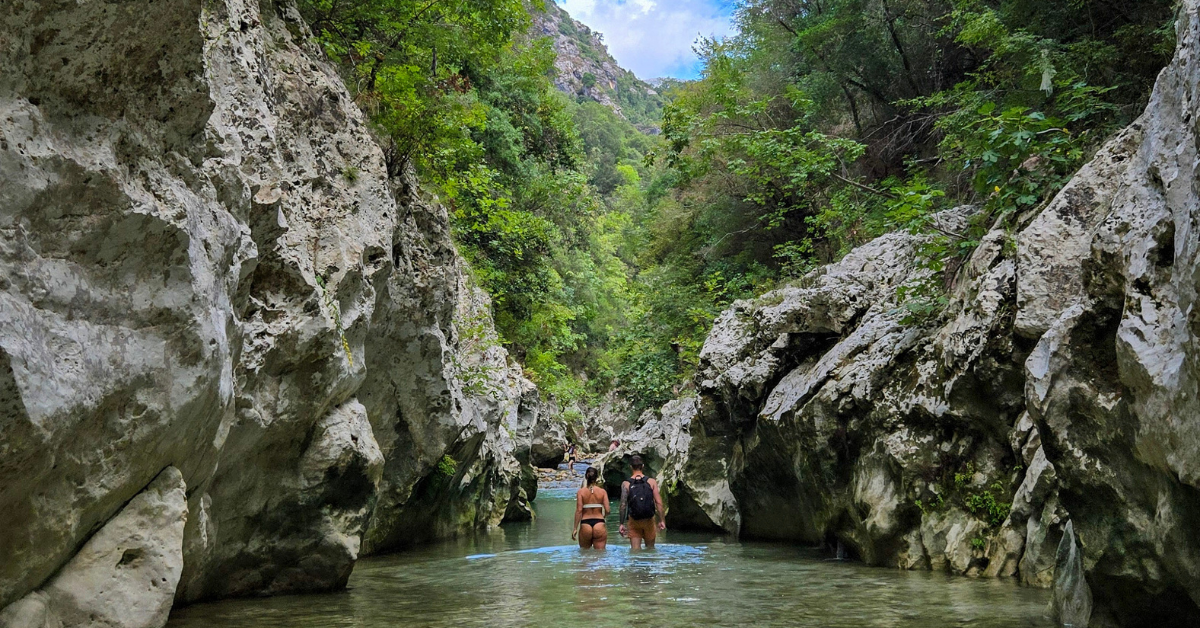
Once you reach the riverside, you park near a small cluster of cafés and shops. This is where most people stop, unaware that the real experience begins where the paths end. You don’t walk alongside the river. You walk through it.
Cold as a God’s Wrath, Quiet as a Prayer
The water is crystal clear, running fast and shallow at first. But as you move upstream, it deepens and narrows. There are stretches where it hugs the cliffs so tightly that you’re funneled between them, with sunlight disappearing into stone. And then, there are the moments that take you by surprise.
For me, there were one or two spots where I had to swim. As in: no-ground-below kind of swim. I’m short, okay? My husband is taller. While he confidently walked through with the air of a mythological hero, I was doing what can only be described as panic-paddling through the underworld.


It’s worth noting here that not bringing the dogs was the right call. As much as we love including them in our adventures, the water was so cold I’m fairly sure our smaller one would’ve gone on hunger strike out of protest.
There’s a particular kind of silence that only exists in places like this. It’s not the absence of sound, but the presence of something else. Something bigger. Maybe it’s the cliffs. Maybe it’s the myth. Maybe it’s just the cold. But the moment I stopped shivering and started listening, I felt it.
A Few Things I Wish I Knew Beforehand

If you’re planning to go, and you should, here are a few tips that might help:
Water shoes are non-negotiable. You will walk on rocks, and you will not enjoy it barefoot.
Bring a change of clothes, or at least a towel. You will be soaked.
Food is limited near the river. We didn’t bring sandwiches. This was a mistake I will carry with me.
There are no lockers or changing rooms, so plan accordingly.
Go early. The first hour or two of the day offer the most peaceful experience.
Why Discomfort Creates Memory
We rarely remember the perfect days. The ones where everything goes smoothly, the food is great, and the weather stays kind. They blend into a pleasant blur. But ask anyone about their favourite travel memory, and chances are they will mention something slightly chaotic. Slightly cold. Slightly hard.
There is a neurological reason for this. Our brains tag discomfort as important, as something that requires full attention. Psychologists call it “flashbulb memory – when a moment of high emotional or physical intensity leaves behind a vivid mental snapshot. It is the same mechanism that helps people recall exactly where they were when something major happened, even decades later.
But science aside, we all know this intuitively. The moments that made us stretch, struggle, or surrender are the ones that stay.
The Acheron trip did not stay with me just because it was beautiful. It stayed because I had to earn it. I had to feel it. And somewhere along the icy curves of that river, I stopped thinking about being uncomfortable and started noticing everything. The weight of the water. The shape of the light. The steady rhythm of my breath.
It may sound counterintuitive, but it is true. The harder the moment, the longer it lasts. Not in pain, but in memory.


The Beauty of the Contrast
What made this day even more surreal was how different it felt from Parga. One moment you are lounging by pastel-colored houses, sipping freddo cappuccinos on the coast. The next, you are neck-deep in mythological waters, wondering whether your fingers are still attached.
That contrast between comfort and challenge, soft and raw, is what made the experience unforgettable.
We returned to Parga that evening tired, hungry, and slightly dazed. We dried off in the sun, ordered everything on the menu, and laughed about the moments that nearly broke us. Because that is the thing about adventures. You do not really know they are adventures until you have made it through.
And Acheron? It is not just a river. It is a rite of passage disguised as a day trip.
Love this post? Pin it!

Other Posts You May Like
-

Belgrade in 3 Visits: A Love Letter in Layers
-

The Ultimate Day Trip in Greece: Swim the Acheron
-

Why Everyone’s Falling in Love with Parga (and You Will Too)
-

Marmore Falls: Italy’s Wildest Waterfall, A Family Story, and Why You Need to Visit Now
-

Ljubljana Travel Mistakes to Avoid + What Made Us Fall in Love
-

Why You’ll Fall in Love with Tivoli’s Villa d’Este
-

The Magic of Everyday Life: A Travel Guide to Noticing More
-

Lost in Venice: A 24-Hour Love Letter to the Floating City
-

24 Hours in Zagreb: The Full Experience